


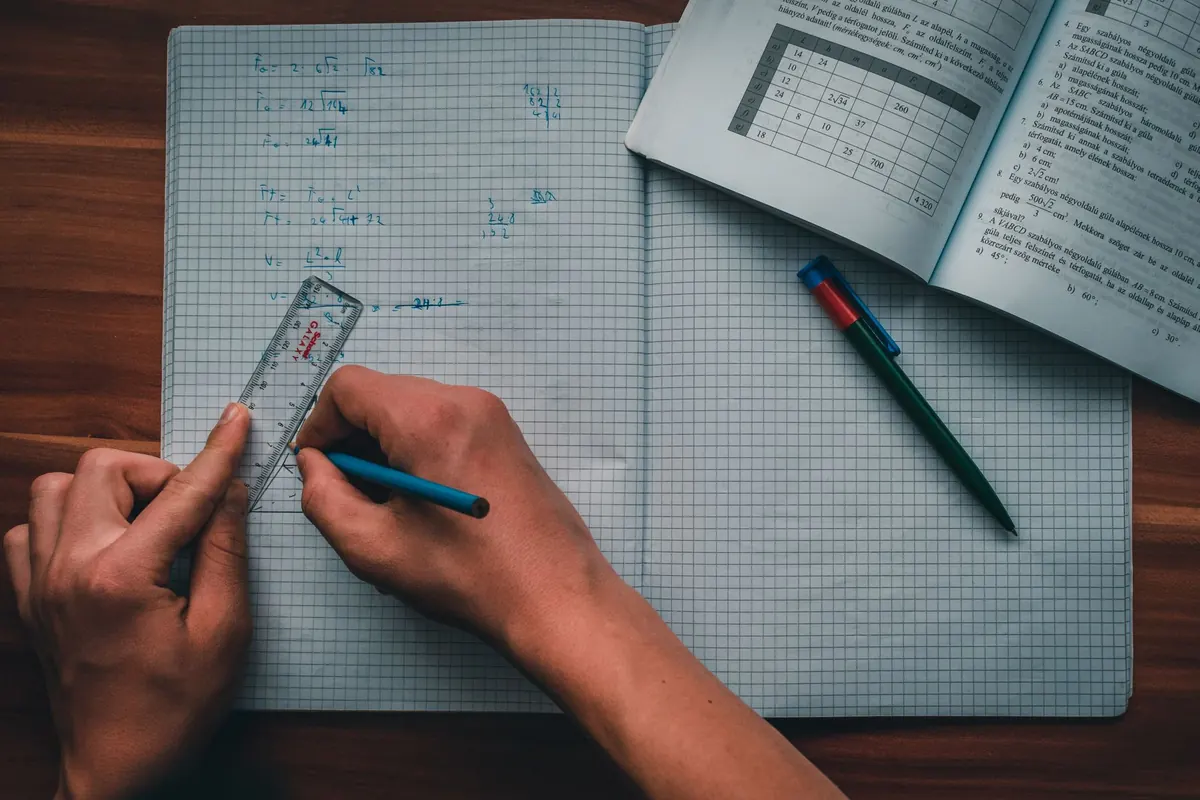

Twenty-five questions, ten minutes, one pen. That is the whole idea behind this mixed set on complementary, supplementary and vertically opposite angles. Work through it in one sitting if you can, because quick recall is exactly what timed questions reward. Attempt every one before you glance at the answers, and jot your reasoning down even when the answer seems obvious — the working is where the marks live.
Before You Start: Three Rules to Keep in Mind
Almost every question below comes back to one of three facts. If you can state them without hesitating, you are ready to go.
- Complementary angles add up to 90°. They usually sit together inside a right angle.
- Supplementary angles add up to 180°. They usually sit together on a straight line.
- Vertically opposite angles are equal. When two straight lines cross, the angles facing each other are identical, and every angle is supplementary to the two beside it.
Two memory hooks worth keeping: a corner goes with complementary, a straight line goes with supplementary. If the two ever blur under pressure, sketch the shape. It takes three seconds and settles the question.
Questions 1–10: Complementary Angles
Give each answer in degrees.
- What is the complement of 37°?
- What is the complement of 62°?
- What is the complement of 45°?
- One angle measures 19°. What is its complement?
- Two complementary angles differ by 20°. What size is each one?
- An angle is twice the size of its complement. Find both angles.
- A right angle is split into three equal angles. How big is each one?
- What is the complement of 71°?
- Are 43° and 47° complementary? Answer yes or no.
- Can two obtuse angles ever be complementary? Explain in one sentence.
Questions 11–18: Supplementary Angles
Same idea, different total. Watch the numbers as they grow.
- What is the supplement of 118°?
- What is the supplement of 90°?
- What is the supplement of 27°?
- One angle measures 65°. What is its supplement?
- Two supplementary angles differ by 40°. What size is each one?
- An angle is three times its supplement. Find both angles.
- What is the supplement of 145°?
- Two angles sit on a straight line. One is 132°. What is the other?
Questions 19–22: Vertically Opposite Angles
- Two straight lines cross. One angle is 55°. What is the size of the angle vertically opposite it, and how big are the other two angles?
- Two straight lines intersect and one angle measures 128°. State the sizes of the other three angles.
- True or false: vertically opposite angles are always equal.
- Two lines cross, and one pair of vertically opposite angles is 47° each. What is the size of each of the remaining angles?
Questions 23–25: Mixed Challenge
- Two angles are complementary. One of them is also the supplement of 145°. What size are the two angles?
- Three angles sit on a straight line: x, 2x and 60°. Find x and list all three angles.
- Two lines cross. One angle is 85°, and the angle vertically opposite it is labelled (2x + 15)°. Find x.
Answers
Mark yourself honestly, and do not let a small arithmetic slip look like a gap in understanding.
- 1. 53°
- 2. 28°
- 3. 45°
- 4. 71°
- 5. 35° and 55°
- 6. 30° and 60°
- 7. 30° each
- 8. 19°
- 9. Yes — 43° + 47° = 90°
- 10. No. An obtuse angle is already greater than 90°, so two of them total more than 180°.
- 11. 62°
- 12. 90°
- 13. 153°
- 14. 115°
- 15. 70° and 110°
- 16. 45° and 135°
- 17. 35°
- 18. 48°
- 19. 55°, with the other two angles 125° each
- 20. 128°, 52° and 52°
- 21. True
- 22. 133° each
- 23. 35° and 55°
- 24. x = 40°, so the angles are 40°, 80° and 60°
- 25. x = 35°
Common Slips and How to Avoid Them
Most lost marks in this topic come from four habits, none of them about ability.
- Swapping 90 and 180. Subtract from the wrong total and everything after it collapses. Say the total out loud as you write it.
- Subtracting from the wrong angle. In a pair, one angle is the given one and one is the answer. Circle the given value first.
- Assuming a diagram is to scale. It rarely is. Two angles that look equal may differ by 30°, so trust the labels, not your eyes.
- Skipping the final sentence. If a question asks for two angles, an answer with one number is half an answer. Finish the thought.
A useful habit for the algebra questions: after solving, add your answers back together. If they do not total 90° or 180°, you will spot it immediately, before anyone marks the page.
Where to Take This Next
Ten minutes of mixed practice beats an hour of reading notes, but only if you repeat it. Try this set cold, then return to it in two or three days and time yourself properly. Aim to finish inside eight minutes with no working written down, then a further two minutes checking each answer by addition. When this page starts to feel easy, extend the same three rules to angles in triangles and around a point, where complementary and supplementary thinking does most of the heavy lifting. Keep a short list of the questions you missed, and redo only those next time — that list is the most useful revision material you will build all term.
Photo: StockSnap / Pixabay